Cost effective solutions to healthcare

Visual safeguards in critical care: the role of colour coded labelling in patient safety

Cognitive overload defines the modern Intensive Care Unit. Clinicians make hundreds of critical decisions every shift while alarms cycle and patient conditions fluctuate rapidly. 

Errors occur not because practitioners lack skill but because the human brain struggles to process dense textual information under extreme fatigue. Standardised labelling functions as an essential defense mechanism in this high pressure environment. 

Visual cues allow medical teams to identify medication classes instantly because the brain processes colour faster than text. Mermed engineers labelling solutions that align with Australian standards to reduce clinical risk and support the workflow of theatre nurses and anaesthetists.

The high cost of medication errors

Medication safety remains a primary concern for Australian healthcare facilities. The Australian Commission on Safety and Quality in Health Care (ACSQHC) identifies medication errors as the second most common type of clinical incident in hospitals. While many of these incidents cause minor harm, the administration of the wrong injectable medicine in an ICU or operating theatre can be catastrophic.

Complex environments amplify the risk. A tired registrar might mistake a neuromuscular blocker for a sedative if the vials look similar and the syringe labels lack distinct visual differentiation. These “syringes swaps” represent a failure of the system rather than the individual.

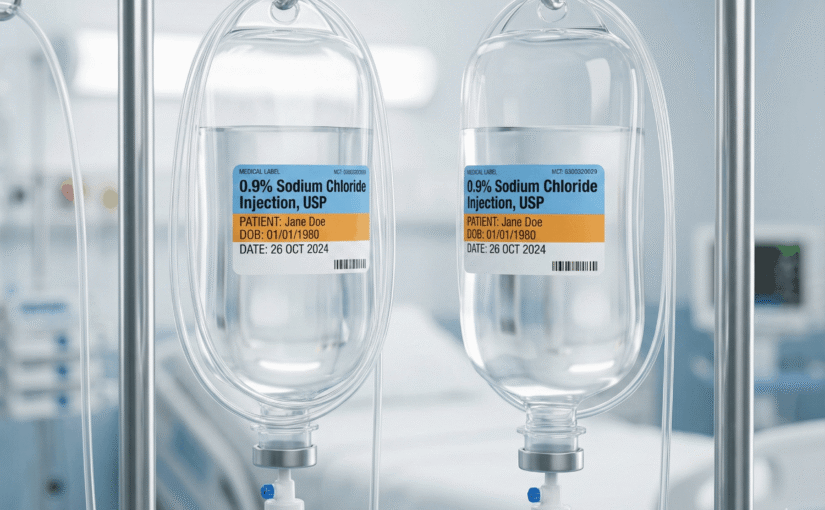
Robust labelling protocols interrupt this error chain. When a theatre nurse reaches for a syringe, the specific background colour provides an immediate secondary check before they even read the drug name. This dual verification process is vital for patient safety during rapid sequence inductions or cardiac emergencies.

Navigating compliance and ISO standards

Adherence to established standards ensures that this visual language remains consistent across different facilities. A locum anaesthetist moving between hospitals must rely on the same colour logic to maintain safety.

Australia follows the National Standard for User-applied Labelling of Injectable Medicines, Fluids and Lines. This standard aligns closely with ISO 26825 regarding the colour coding of syringe labels for anaesthesia. The protocol assigns specific Pantone colours to drug classes to prevent misidentification.

Key colour designations

  • Blue: Opioids (e.g., Fentanyl, Morphine)
  • Red: Muscle Relaxants
  • Yellow: Induction Agents
  • Orange: Benzodiazepines
  • Violet: Vasopressors

Mermed manufactures labels that adhere strictly to these colour standards. We ensure the Pantone matching is precise because a faded or incorrect shade can cause confusion during a crisis. Our production team understands that compliance is binary. A label either meets the standard or it creates liability.

Engineering for clinical workflow

Procurement managers often view labels as a commodity, yet the engineering behind the adhesive and material impacts clinical efficiency. A label that falls off a refrigerated IV bag creates an immediate unidentified substance risk. A label that leaves residue on a reusable tray compromises sterility protocols in the CSSD.

We design our labels to withstand the specific rigours of the Australian healthcare environment. The adhesive must grip distinct surfaces, from plastic syringe barrels to giving sets, without flagging or peeling. This reliability reduces the cognitive load on staff who should focus on the patient rather than checking if a label is secure.

Workflow integration also matters deeply. Theatre Nurse Managers require dispensing systems that allow for single handed operation. We provide dispenser boxes and rolls that fit standard theatre carts because setup time affects case turnover. Although these details seem minor, they cumulatively save hours of nursing time over a financial year.

The risk of offshore supply chains

Recent global disruptions highlighted the fragility of relying on offshore manufacturers for critical medical consumables. A stockout of compliant anaesthetic labels forces hospitals to use generic alternatives or handwritten tape. This reversion destroys the safety net that the standardisation provides.

Facilities that partner with local manufacturers mitigate this supply chain risk. Mermed operates as an Australian engineering and manufacturing firm. We maintain local stock levels and possess the capability to ramp up production rapidly if demand spikes. Procurement teams gain certainty that their compliance requirements will be met regardless of international shipping delays.

Beyond the operating theatre

While anaesthesia drives the demand for colour coded labels, the logic applies across the entire hospital ecosystem. Emergency Departments utilise specific labelling for lines and catheters to prevent route errors. An intrathecal medication administered intravenously can be fatal. Distinct labelling for different routes of administration acts as a physical barrier to these events.

The National Standard mandates clear identification of all lines and catheters. We produce peel off labels that integrate with existing admission paperwork and bedside workflows. This integration ensures that documentation tracks the physical application of the label. It closes the loop between the clinical action and the medical record.

Partnership for audit readiness

Hospital administrators face constant pressure to demonstrate compliance during accreditation cycles. Auditors examine how a facility manages injectable medicines and prevents adverse drug events. Inconsistent labelling is a frequent non compliance finding.

We act as a partner in this process rather than just a vendor. Our team works with CSSD managers and pharmacy departments to audit their current labelling stock against the latest version of the National Standard. We identify gaps where outdated labels might still be in circulation. This proactive approach ensures that when an auditor inspects the anaesthetic trolley or the ICU medication room, they find a fully compliant system.

Safety where it matters most

Patient safety relies on layers of defence. Colour coded labelling serves as a critical visual barrier against medication errors in high stress environments. By adhering to ISO 26825 and the National Standard, hospitals protect both their patients and their practitioners. 

Mermed remains committed to engineering high precision, compliant labelling solutions locally. We ensure that Australian healthcare providers have the reliable tools they need to maintain safety and efficiency where it matters most.
Barcode labelling systems: reducing clinical error rates in Australian labs and pharmacies

Manual transcription remains the single largest vector for clinical error in Australian pathology and pharmacy workflows. 

When a clinician relies on handwriting or manual data entry to track specimens, the probability of a “never event” increases significantly. Hospital procurement managers and nurse unit managers understand that the cost of a mislabelled sample extends far beyond the financial burden of re-testing. It compromises patient safety and erodes trust in the healthcare facility.

Integrating robust barcode labelling systems is no longer a luxury for high-volume laboratories; it is a fundamental requirement for risk management. The shift from analogue identification to digital scanning removes the variable of human fatigue from the equation. 

While many facilities have adopted basic scanning, the next tier of compliance involves end-to-end tracking that integrates seamlessly with Laboratory Information Systems (LIS) and Hospital Information Systems (HIS). Mermed engineers solutions that bridge the gap between physical inventory and digital records because we recognise that precision is the only acceptable standard in healthcare.

Quantifying the impact of automating identification

The argument for automation often centres on speed, yet the primary dividend is safety. A pivotal study published in Frontiers in Medicine analysed the impact of barcode-based tracking on pre-analytical errors. The data revealed that barcoding reduced laboratory testing errors from 2.26 to just 0.17 per 10,000 specimens. This drastic reduction illustrates how technology acts as a rigid firewall against the cognitive slips that occur during high-pressure shifts.

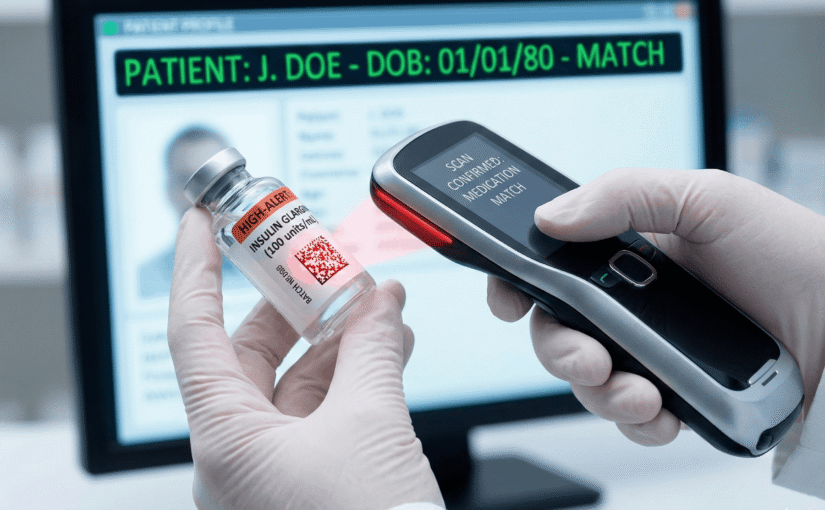
This level of precision is critical when managing high-alert medications or irreplaceable biopsy samples. The Australian Commission on Safety and Quality in Health Care (ACSQHC) reports that medication errors remain a significant cause of hospital admissions and adverse events. By implementing point-of-care barcode scanning, pharmacies effectively force a digital “hard stop” if a medication does not match the patient’s electronic profile. This workflow allows pharmacists and technicians to focus on clinical validation rather than rote verification.

Implementing these systems requires more than purchasing a scanner. It demands an audit of the physical environment where labelling occurs. Labels must withstand cryogenic freezing, autoclave sterilisation, and chemical exposure without degrading. A barcode that becomes unreadable due to moisture or abrasion renders the entire tracking system useless.

Meeting NSQHS standards through digital precision

Australian healthcare facilities operate under the strict governance of the National Safety and Quality Health Service (NSQHS) Standards. Standard 6 specifically addresses Communicating for Safety, with a heavy emphasis on correct patient identification and procedure matching. Manual checks are inherently fallible because they rely on the “two-person check” methodology, which is susceptible to confirmation bias.

Barcode labelling systems support accreditation by creating an immutable digital audit trail. When a nurse scans a patient’s wristband and the corresponding medication label, the system logs the interaction with a timestamp and user ID. This automated documentation proves invaluable during accreditation audits. It demonstrates that the facility does not merely have a policy for patient safety but employs engineered controls to enforce it.

Clinical leaders co-design these workflows to ensure they do not add friction to clinical care. A well-designed system functions in the background. It should empower practitioners to work faster while maintaining stricter compliance guardrails. When the scanner beeps, it provides immediate confirmation that the chain of custody is intact.

Optimising inventory control and supply chain security

Beyond patient safety, barcode technology stabilises the often volatile supply chain within hospital pharmacies and pathology centres. Stockouts of critical reagents or medications disrupt patient care and force procurement teams into reactive, expensive purchasing cycles. Manual inventory counts are time-consuming and prone to counting errors that skew data.

Automated inventory tracking creates real-time visibility. As items are scanned upon receipt and again upon dispensation, the central system updates stock levels instantly. This data allows for predictive modelling. Procurement managers can identify usage trends and adjust par levels before a shortage occurs.

GS1 Australia highlights that standardised barcoding across the supply chain improves traceability for recalls. If a specific batch of reagent is flagged for a quality issue, a robust system allows the laboratory manager to instantly locate every affected unit. This capability transforms a potential crisis into a manageable administrative task. It protects the facility from using compromised stock and ensures continuity of care.

Engineering a fail-safe workflow

Adopting this technology requires a partnership between clinical staff, IT departments, and solution providers. The hardware must suit the physical constraints of the workspace, and the consumables must match the specific rigours of the environment. Mermed supports this transition by supplying locally engineered labelling solutions designed specifically for Australian medical contexts.

Key considerations for a robust system include:

  • Substrate Durability: Labels for pathology must survive liquid nitrogen storage and tissue processing chemicals.
  • Adhesive Performance: Labels must adhere securely to curved surfaces like vials and test tubes without flagging or peeling.
  • Print Clarity: High-resolution thermal printing ensures 2D barcodes remain scannable even at small sizes.
  • Integration: The middleware must communicate flawlessly with existing patient administration systems to prevent data silos.

We encourage procurement and nurse unit managers to view labelling not as a consumable cost but as a component of their safety infrastructure. The investment in high-quality, validated labels and scanning hardware pays for itself by preventing the catastrophic costs associated with clinical error.

Barcode labelling reduces clinic error rates

The transition to fully automated barcode labelling systems is a critical step in modernising Australian pathology and pharmacy operations. The evidence is clear. Dropping error rates from over two per 10,000 to nearly zero represents a profound improvement in patient safety. 

By aligning with NSQHS standards and leveraging technology to secure the supply chain, healthcare providers protect their patients and their practitioners. Precision creates safety, and in our field, safety is everything.

Precision in the dental practice: labelling to reduce risk

A single unrecorded sterilisation cycle compromises an entire week of patient care. Infection control breaches remain the silent threat in dental operatories, capable of closing practices and ending careers. 

The Australian Health Practitioner Regulation Agency (AHPRA) reported 1,446 notifications regarding dental practitioners in the 2022/23 financial year, and infection control complaints continue to feature prominently in regulatory actions. Documentation serves as the only defence against these allegations.

Dental professionals operate in high pressure environments where cognitive load peaks during complex procedures. Clinical staff juggle patient anxiety, technical precision, and strict time constraints. In this context, a label acts as more than a sticker. A label functions as a critical control point. Precision in labelling transforms abstract safety concepts into tangible, auditable evidence. This approach aligns dental clinic best practices with the rigorous standards seen in hospital operating theatres.

Why do dental clinic best practices hinge on traceability?

Regulatory bodies demand evidence that instruments used on a patient were sterile at the time of use. If your clinic is still using AS/NZS 4815:2006, you’re working under an outdated framework. AS 5369:2023 now serves as the modernised, risk-based operational standard for infection control and sterilisation in Australia. Unlike previous standards, AS 5369 applies broadly to all healthcare environments, including dental clinics.

AS 5369 mandates detailed records of each sterilisation cycle, including load identification, operator initials, and sterilisation cycle data. You cannot simply trust the autoclave passed. You must prove it passed.

Manual tracking often fails because human error is inevitable during busy turnover periods. A robust labelling system bridges this gap. When staff apply a label containing the cycle number, steriliser number, and date to every pouch, they create an unbroken chain of custody. This data must link back to the patient record. If a patient alleges a cross-infection occurring six months post-treatment, the practice can retrieve the specific cycle data that cleared the instruments used in that appointment.

Traceability protects the practitioner as much as the patient. The Dental Board of Australia expects strict adherence to these protocols. Failure to produce records suggests failure to sterilise. Mermed produces labelling solutions that integrate these variables into the daily workflow without adding time to the process.

How does visual logic prevent medication errors?

Dental operatories contain clear liquids that look identical but act differently. Sodium hypochlorite, local anaesthetic, and saline solution often sit in proximity on the bracket table. A mix-up here leads to catastrophic soft tissue trauma or systemic toxicity. The Australian Commission on Safety and Quality in Health Care (ACSQHC) identifies medication safety as a national priority, yet dental practices often rely on memory or temporary markers.

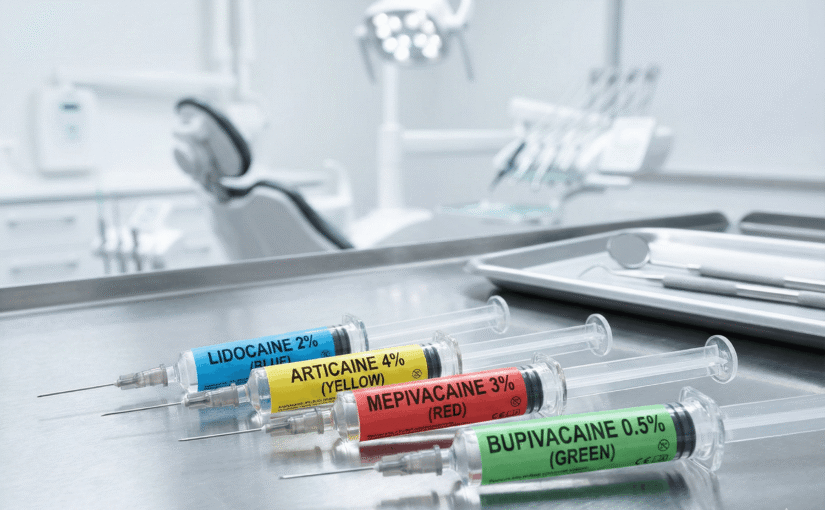
Standardised labelling removes the guesswork. Pre-printed labels for specific dental fluids utilise colour coding and clear text to signal contents immediately. This visual logic bypasses the need for the clinician to analyse a syringe mid-procedure. The brain recognises the colour pattern faster than it reads text.

Implementing a “labelling at the source” protocol ensures that any medicine drawn up is identified immediately. This reduces the cognitive burden on the dentist and the dental assistant. They can focus on the procedure because the safety infrastructure supports their decision making.

What is the financial risk of poor compliance?

An audit failure costs more than the fine. It costs the practice its reputation and operational days. When a state health department investigates a breach, the practice may face closure until they can demonstrate compliance. Revenue stops while overheads continue.

Investing in high quality labelling materials acts as an insurance policy for business continuity. Generic office labels often fail under the extreme conditions of steam sterilisation. If a label detaches inside the autoclave chamber, it can damage the equipment, leading to expensive repair bills and downtime. If the ink runs or fades, the legal record becomes void.

Mermed designs labels specifically for the Australian healthcare environment. These materials withstand the heat, moisture, and pressure of sterilisation cycles. They adhere to wraps and pouches without compromising the barrier system. Choosing purpose engineered materials demonstrates a commitment to quality assurance that auditors respect.

How can hospital grade solutions fit the dental workflow?

Many dental practice owners believe hospital grade traceability is too complex for a small clinic. This assumption leads to dangerous workarounds. However, AS 5369 is now closely aligned with hospital standard AS/NZS 4187, ensuring consistency between hospital sterilisation practices and primary care facilities. The goal is to adapt the rigour of the Central Sterile Services Department (CSSD) to the footprint of a sterilisation room.

Mermed partners with dental clinics to implement systems that fit their specific volume. Because every clinic layout differs, the solution must be flexible. Standardised documentation books, scanning guns, and double adhesive labels streamline the process. Staff simply peel the label from the pouch and affix it to the patient file. This action takes seconds but secures the compliance loop permanently.

Adopting these systems signals to patients that their safety drives every decision. While patients may not understand the mechanics of an autoclave, they notice the professionalism of a barcoded, tracked sterile pack. It builds trust. It reinforces the value of the care provided.

Shift from assumption to verification

Precision involves more than the drill. True clinical precision encompasses the entire ecosystem of care, from the sterilisation room to the patient record. Labelling provides the structural integrity for this ecosystem. It ensures that every instrument, medication, and file communicates truth.

Dental clinic best practices require a shift from assumption to verification. By transitioning to the AS 5369 standard and implementing rigorous labelling protocols, practices reduce the risk of adverse events and regulatory penalties while driving operational excellence. Mermed supports this transition with Australian engineered solutions designed for the realities of clinical practice. Safety is not a variable. It is the foundation.

Safety at a glance: enhancing healthcare facility safety and compliance through visual cues

Visual clarity defines the difference between a seamless clinical handover and a critical incident. 

In the high-pressure environment of an Australian hospital, a Nurse Unit Manager or CSSD technician makes hundreds of micro-decisions every hour. Every second spent decoding navigation or hazard warnings adds unnecessary cognitive load. 

Mermed produces floor signage and labelling solutions to eliminate this ambiguity. We treat visual communication not as decoration, but as a fundamental component of the clinical infrastructure.

Why visual communication systems matter in clinical settings

Hospitals are complex ecosystems where urgency often overrides caution. Staff moving patients between wards or technicians transporting sterile instruments require immediate environmental feedback. A robust system of floor signs and labels functions as a silent traffic controller. It guides behaviour, delineates zones, and warns of hazards without requiring verbal intervention.

This approach aligns with the Hierarchy of Controls used in occupational health and safety. While elimination and engineering controls remain superior, administrative controls like clear signage provide a critical layer of defence against human error. Effective visual cues reduce the mental bandwidth required for navigation. This preservation of attention allows clinicians to focus entirely on patient care and protocol adherence.

Mitigating slips, trips, and falls with precision

Slips, trips, and falls represent a persistent threat to both staff safety and patient outcomes. Safe Work Australia reported that the Health Care and Social Assistance industry accounted for 19% of all serious workers’ compensation claims in 2022-23. A significant proportion of these injuries stem from environmental hazards, including wet floors or obstructed pathways.

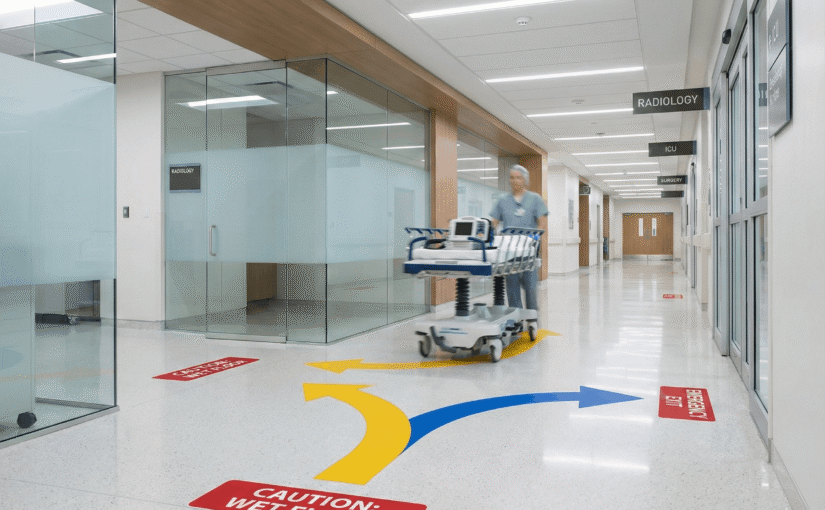
Standard “Wet Floor” cones often create obstruction hazards themselves or vanish into storage cupboards when needed most. Adhesive floor signage provides a permanent or semi-permanent solution that remains visible without impeding foot traffic or bed movement. Placing directional markers and hazard warnings directly in the line of sight ensures compliance with safety protocols.

The Australian Commission on Safety and Quality in Health Care (ACSQHC) emphasises preventing falls as a key standard. Hospitals must demonstrate active strategies to minimise these risks during accreditation audits. Installing immovable, high-visibility floor warnings demonstrates a proactive commitment to these National Safety and Quality Health Service (NSQHS) Standards.

Zoning strategies for infection control and CSSD

Sterility assurance relies on strict separation between clean and dirty workflows.

In a Central Sterile Services Department (CSSD), the risk of cross contamination increases whenever a staff member crosses a zone boundary unintentionally. Floor markings act as hard borders for these invisible barriers.

Key applications for floor labelling

  • Biohazard demarcation: Clearly outlining dirty utility rooms prevents unauthorised entry by non-clinical staff or visitors.
  • Sterile storage zones: Red or yellow floor taping indicates areas where only scrubbed personnel may enter.
  • Traffic flow direction: Arrows guide the one-way flow of instruments from decontamination to sterilisation, preventing backtracking.
  • Trolley parking bays: Designated spots for mobile equipment ensure fire exits remain clear and equipment remains locatable.

Implementing colour coded zones aids rapid visual processing. Staff know instinctively that a red floor line signifies a high risk area, while green indicates a safe zone. This binary clarity reduces decision fatigue and supports adherence to AS/NZS 4187 reprocessing standards.

Durability in aggressive cleaning environments

Healthcare facilities subject their infrastructure to rigorous cleaning regimes. Standard vinyl stickers from generalist stationery suppliers fail rapidly under exposure to hospital grade disinfectants. Chlorine, bleach, and quaternary ammonium compounds degrade inferior adhesives and fade inks within weeks.

Mermed designs labels and floor signs specifically for this chemical onslaught. We use industrial grade materials capable of withstanding heavy foot traffic, trolley wheels, and aggressive scrubbing. A peeling floor label creates a new infection trap by harbouring bacteria in the adhesive residue. Our solutions maintain integrity, ensuring the label remains a safety feature rather than becoming a biological hazard itself.

Optimising inventory and storage workflows

Procurement managers know that disorganised storerooms haemorrhage budget through expired stock and emergency ordering. Floor labels play a vital role in 5S (Sort, Set in order, Shine, Standardise, Sustain) methodologies applied to medical storage.

Marking specific floor areas for bulk equipment or pallets ensures everything returns to its designated home. When a locum nurse enters a supply room at 2 AM, clear floor markings and shelf labels allow them to locate a specific catheter or infusion pump immediately. This system eliminates time wasted searching and prevents the hoarding of equipment in unauthorised areas.

Partnering for turnkey compliance solutions

Architects and fit out managers often treat signage as an afterthought. Integrating a visual communication strategy during the design or refurbishment phase prevents retrofitting costs later. Mermed collaborates with facility planners to design extensive communication systems that meet Australian Standards from day one.

We understand that every facility presents unique spatial challenges. A heritage listed wing in a regional hospital requires different signage solutions than a modern metro day surgery. Our team assesses the specific surface types and traffic volumes to recommend the correct adhesive strength and material durability.

Safety by design

Floor signs and labels effectively bridge the gap between written policy and physical practice by providing the “nudge” that keeps workflows compliant and staff safe. Investing in high quality, purpose engineered visual cues is a capital investment in operational efficiency. 

Mermed supports Australian healthcare providers by delivering solutions that withstand the rigours of clinical use while maintaining absolute clarity. 

Safety happens by design, not by accident.