Client
 Distributor
 Items
Items


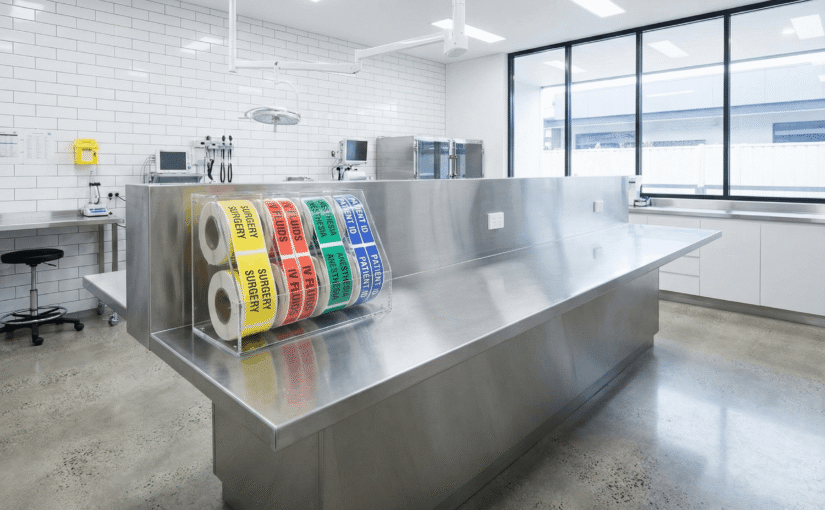
Surgical site infections in veterinary practice represent more than a clinical setback; they undermine the trust between a practice and the pet owner.
As veterinary medicine advances towards complex orthopaedic and soft tissue procedures, the expectations for sterility assurance now mirror those in human hospitals. The days of ambiguous masking tape and handwritten dates on instrument packs are ending.
Modern veterinary facilities are adopting the rigorous identification protocols found in a Central Sterile Services Department (CSSD) to mitigate risk and ensure patient safety.
The one health approach to infection control
Infection prevention is a universal challenge that spans species boundaries.
The Australian Government’s National Antimicrobial Resistance Strategy highlights that effective infection prevention and control (IPC) in animal health is critical to slowing the development of resistant bacteria. Veterinary clinics play a frontline role in this defence. Because pathogens do not distinguish between a human theatre and a veterinary surgery, the protocols designed to contain them must remain equally robust.
Human hospitals operate under strict standards such as AS/NZS 4187 and AS/NZS 4815. These standards dictate that every sterilised item must be traceable to the patient, the cycle, and the steriliser used. Veterinary practices are increasingly aligning with these benchmarks voluntarily to protect their patients and their business reputation. This alignment requires a shift from viewing sterilisation as a cleaning task to viewing it as a validated production process.
The hidden risks in manual labelling
Many veterinary practices still rely on generic office supplies for sterile pack identification. Using standard permanent markers or non specific tape introduces subtle but significant risks into the surgical workflow. Ink from standard markers can penetrate paper and plastic peel pouches during the high heat of an autoclave cycle. This leaching may contaminate the instruments inside, which introduces chemical toxins to the surgical site.
Ambiguity creates another layer of danger. A handwritten date is often illegible or incomplete. If a pack lacks a clear cycle number or steriliser identification, tracking a failure becomes impossible. When an autoclave cycle aborts or a biological indicator fails, staff must be able to immediately identify and recall every pack from that specific load. Without precise batch labelling, a practice cannot execute this recall effectively. This inability leaves patients vulnerable to instruments that are clean but not sterile.
Engineering a traceable workflow
Adopting a labelling system engineered for clinical use solves these traceability gaps.
A compliant label serves as the primary communication tool between the sterilisation area and the surgical suite. It provides indisputable evidence that a pack has been exposed to the sterilisation process.
Chemical indicators provide immediate visual assurance
Human grade labels often incorporate Type 1 chemical process indicators.
These indicators change colour when exposed to steam or plasma sterilisation agents. While they do not verify sterility (which requires biological monitoring), they provide an immediate visual check for the scrub nurse or veterinarian.
This differentiation prevents the catastrophic error of using an unprocessed pack that was accidentally placed on a sterile storage shelf.
ISO compliant adhesives
Labels used in veterinary clinics must withstand harsh conditions.
They face high pressure steam, vacuum phases, and varying storage temperatures. Standard office labels often peel or detach during these cycles. A medical grade label uses adhesives validated to adhere securely to wrap or rigid containers throughout the expansion and contraction of the sterilisation cycle.
This security ensures the data remains attached to the instrument set until the moment of use.
Moving from process to protocol
Implementation of these standards requires a cultural shift within the practice.
Veterinary nurses and technicians are often time poor and manage multiple roles simultaneously. A structured labelling system reduces cognitive load by standardising the information required for every pack.
Key data points for veterinary labels
- Steriliser number: Identifies which machine processed the load.
- Cycle or load number: Links the pack to the specific physical printout or data log of that cycle.
- Date of sterilisation: Establishes the timeline for shelf life and stock rotation.
- Pack content description: Clearly identifies instruments without requiring staff to handle or guess the contents of a wrapped tray.
- Operator identification: accountability for who prepared and released the load.
Clear identification streamlines the setup of the operating theatre. Staff can select packs with confidence because they can read the expiry status and verify the exposure indicator in a single glance.
This clarity removes hesitation and allows the clinical team to focus entirely on the patient.
The economic case for precision
Investment in proper sterilisation labelling is often viewed as a consumable cost, yet it functions as an insurance policy. The cost of treating a single deep surgical site infection can run into thousands of dollars in antibiotics, revision surgery, and supportive care. In many cases, the veterinary practice absorbs these costs to maintain client relations.
Preventing cross contamination through rigorous instrument management protects the bottom line. It also demonstrates a commitment to excellence that clients notice.
Pet owners are increasingly sophisticated regarding medical care. When they see a practice using hospital grade tracking systems, it reinforces the value of the professional services provided.
Partnering for clinical excellence
The transition to higher standards does not have to be complex. Mermed engineers labelling solutions that integrate seamlessly into existing veterinary workflows. These solutions are designed to meet the rigorous demands of Australian healthcare facilities and are equally effective in high volume veterinary hospitals.
By adopting these tools, veterinary practices do more than just label a bag. They create a chain of custody for every scalpel, forcep, and clamp. This chain of custody ensures that when a veterinarian makes an incision, they do so with the full confidence that their equipment meets the highest standards of safety.
Sterility is absolute. The systems used to track it must be equally precise.