Client
 Distributor
 Items
Items


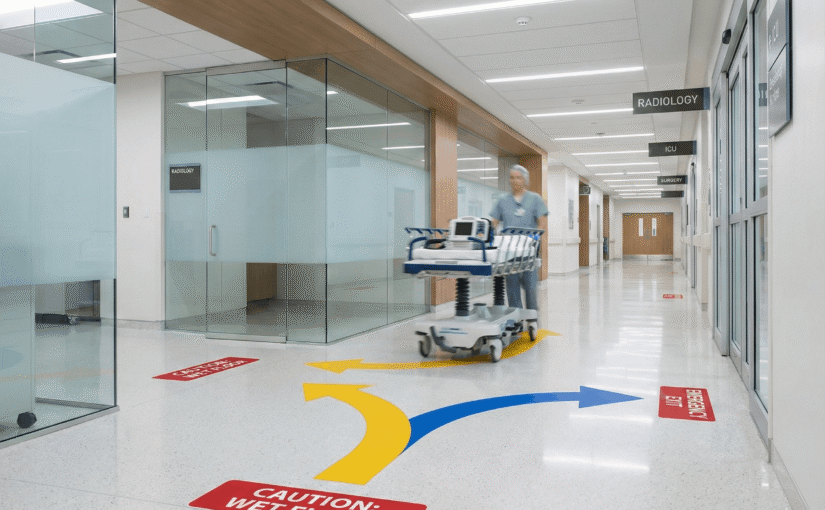
Visual clarity defines the difference between a seamless clinical handover and a critical incident.
In the high-pressure environment of an Australian hospital, a Nurse Unit Manager or CSSD technician makes hundreds of micro-decisions every hour. Every second spent decoding navigation or hazard warnings adds unnecessary cognitive load.
Mermed produces floor signage and labelling solutions to eliminate this ambiguity. We treat visual communication not as decoration, but as a fundamental component of the clinical infrastructure.
Why visual communication systems matter in clinical settings
Hospitals are complex ecosystems where urgency often overrides caution. Staff moving patients between wards or technicians transporting sterile instruments require immediate environmental feedback. A robust system of floor signs and labels functions as a silent traffic controller. It guides behaviour, delineates zones, and warns of hazards without requiring verbal intervention.
This approach aligns with the Hierarchy of Controls used in occupational health and safety. While elimination and engineering controls remain superior, administrative controls like clear signage provide a critical layer of defence against human error. Effective visual cues reduce the mental bandwidth required for navigation. This preservation of attention allows clinicians to focus entirely on patient care and protocol adherence.
Mitigating slips, trips, and falls with precision
Slips, trips, and falls represent a persistent threat to both staff safety and patient outcomes. Safe Work Australia reported that the Health Care and Social Assistance industry accounted for 19% of all serious workers’ compensation claims in 2022-23. A significant proportion of these injuries stem from environmental hazards, including wet floors or obstructed pathways.
Standard “Wet Floor” cones often create obstruction hazards themselves or vanish into storage cupboards when needed most. Adhesive floor signage provides a permanent or semi-permanent solution that remains visible without impeding foot traffic or bed movement. Placing directional markers and hazard warnings directly in the line of sight ensures compliance with safety protocols.
The Australian Commission on Safety and Quality in Health Care (ACSQHC) emphasises preventing falls as a key standard. Hospitals must demonstrate active strategies to minimise these risks during accreditation audits. Installing immovable, high-visibility floor warnings demonstrates a proactive commitment to these National Safety and Quality Health Service (NSQHS) Standards.
Zoning strategies for infection control and CSSD
Sterility assurance relies on strict separation between clean and dirty workflows.
In a Central Sterile Services Department (CSSD), the risk of cross contamination increases whenever a staff member crosses a zone boundary unintentionally. Floor markings act as hard borders for these invisible barriers.
Key applications for floor labelling
- Biohazard demarcation: Clearly outlining dirty utility rooms prevents unauthorised entry by non-clinical staff or visitors.
- Sterile storage zones: Red or yellow floor taping indicates areas where only scrubbed personnel may enter.
- Traffic flow direction: Arrows guide the one-way flow of instruments from decontamination to sterilisation, preventing backtracking.
- Trolley parking bays: Designated spots for mobile equipment ensure fire exits remain clear and equipment remains locatable.
Implementing colour coded zones aids rapid visual processing. Staff know instinctively that a red floor line signifies a high risk area, while green indicates a safe zone. This binary clarity reduces decision fatigue and supports adherence to AS/NZS 4187 reprocessing standards.
Durability in aggressive cleaning environments
Healthcare facilities subject their infrastructure to rigorous cleaning regimes. Standard vinyl stickers from generalist stationery suppliers fail rapidly under exposure to hospital grade disinfectants. Chlorine, bleach, and quaternary ammonium compounds degrade inferior adhesives and fade inks within weeks.
Mermed designs labels and floor signs specifically for this chemical onslaught. We use industrial grade materials capable of withstanding heavy foot traffic, trolley wheels, and aggressive scrubbing. A peeling floor label creates a new infection trap by harbouring bacteria in the adhesive residue. Our solutions maintain integrity, ensuring the label remains a safety feature rather than becoming a biological hazard itself.
Optimising inventory and storage workflows
Procurement managers know that disorganised storerooms haemorrhage budget through expired stock and emergency ordering. Floor labels play a vital role in 5S (Sort, Set in order, Shine, Standardise, Sustain) methodologies applied to medical storage.
Marking specific floor areas for bulk equipment or pallets ensures everything returns to its designated home. When a locum nurse enters a supply room at 2 AM, clear floor markings and shelf labels allow them to locate a specific catheter or infusion pump immediately. This system eliminates time wasted searching and prevents the hoarding of equipment in unauthorised areas.
Partnering for turnkey compliance solutions
Architects and fit out managers often treat signage as an afterthought. Integrating a visual communication strategy during the design or refurbishment phase prevents retrofitting costs later. Mermed collaborates with facility planners to design extensive communication systems that meet Australian Standards from day one.
We understand that every facility presents unique spatial challenges. A heritage listed wing in a regional hospital requires different signage solutions than a modern metro day surgery. Our team assesses the specific surface types and traffic volumes to recommend the correct adhesive strength and material durability.
Safety by design
Floor signs and labels effectively bridge the gap between written policy and physical practice by providing the “nudge” that keeps workflows compliant and staff safe. Investing in high quality, purpose engineered visual cues is a capital investment in operational efficiency.
Mermed supports Australian healthcare providers by delivering solutions that withstand the rigours of clinical use while maintaining absolute clarity.
Safety happens by design, not by accident.